
14 APRIL 2026
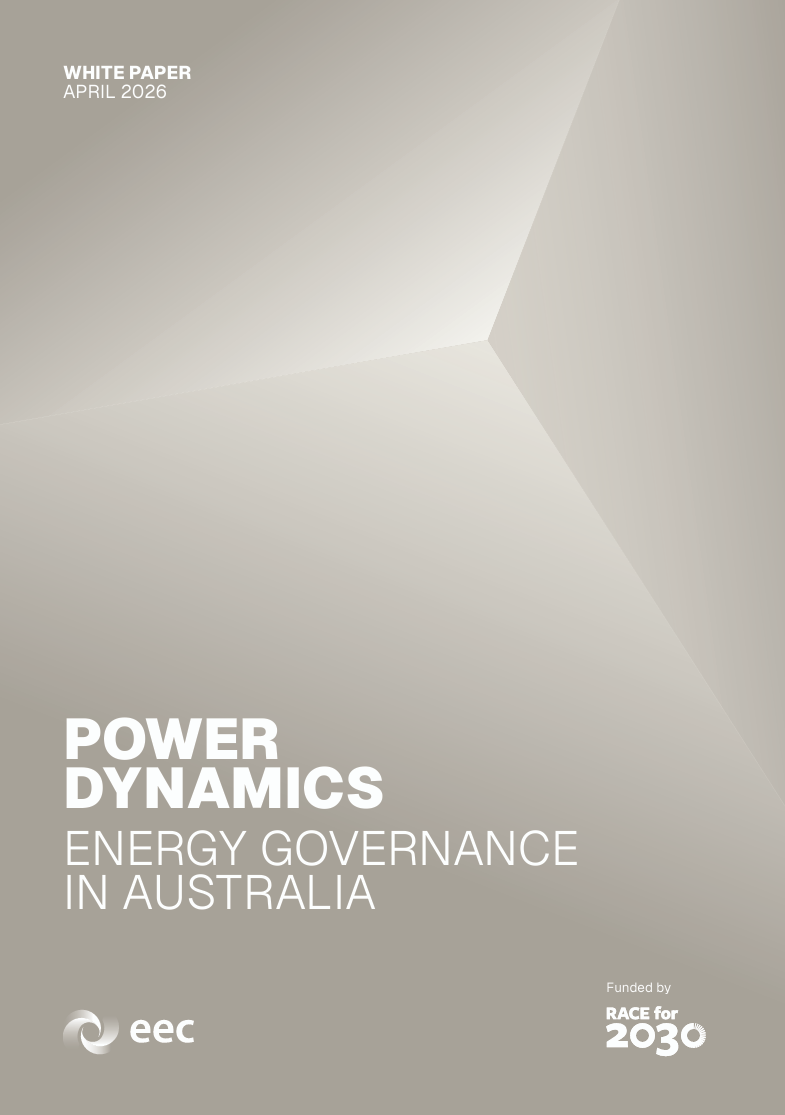
Australia’s energy transition has the potential to be supercharged by stronger coordination, deeper engagement and a clearer shared direction for the future among governance. That’s according to a new White Paper funded by RACE for 2030, and released by the Energy Efficiency Council (EEC).
Authored by independent expert Rob Murray-Leach, Power Dynamics draws on research, public consultation and confidential interviews with more than 100 energy sector leaders. The report examines responses to rapid technological change, accelerating electrification and the increasing role of households and businesses in shaping energy outcomes.
Murray-Leach argues that Australia’s energy system is now being shaped as much by everyday consumer decisions as it is by large scale infrastructure and market design. As electricity underpins transport, housing and industry, the report highlights the need to integrate consumer, demand side and supply side considerations into long term governance.
RACE for 2030 Chief Executive Dr Bill Lilley said this shift reinforces the importance of developing shared understanding across the sector.
“When millions of households and businesses are actively shaping the system, decisions can no longer be made in isolation or within narrow institutional boundaries.”
“A shared view of the future grid can help connect those individual choices with the outcomes the system needs to deliver over time,” Dr Lilley said.
The report also points to the growing challenge of governing a system where responsibilities and decisions are distributed across multiple institutions, jurisdictions and policy domains. Among the key recommendations is the creation of space for longer term, evidence based and deliberative discussion, sitting alongside formal policy and rule change processes.
Dr Lilley said this kind of space is increasingly important, and can strengthen existing governance, rather than add to it.
“Formal processes are critical, but they don’t always leave room to look far enough ahead.”
“Deliberate spaces to explore trade-offs, test assumptions and engage with evidence help leaders lift their gaze beyond immediate pressures and think more clearly about where the system needs to head,” Dr Lilley said.
The report’s extensive consultation with experts directly feeds into the design of Australia’s first ever Consumer Grid Summit in Sydney on June 24-25, convened by RACE for 2030.
The Summit will bring leaders together from across government, industry, research and consumer organisations to build shared understanding of a consumer led future grid and identify practical pathways to get there.
Dr Lilley said the Consumer Grid Summit approach continues this report’s work in drawing together diverse perspectives from across the energy system.
“The major strength of this report is the way it brings together insights from government, industry, researchers and practitioners who all see the system from different angles.”
“The Consumer Grid Summit is built on that same principle and designed to pull leaders outside of their day to day policy and rule change pressures.”
“By working from a common understanding of the future system we’re trying to support, we can then design the processes needed to meet that future vision.”
“That kind of shared, cross sector dialogue is increasingly important as the grid becomes more consumer led and more interconnected with how Australians live and work,” Dr Lilley said.
Related News and Events
Jun 24 2026
Energy leaders unite with trailblazers to shape the future at Consumer Grid Summit
23 June 2026 The energy sector leaders of today will join the trailblazers of tomorrow for an Australian-first initiative to supercharge the energy transformation:...
Jun 10 2026
Emerging energy leaders called to step forward as national Consumer Grid Summit dates are announced
THURSDAY 17 MARCH RACE for 2030 is calling on the current and future generation of energy sector leaders to be part of a new national initiative...
Jun 05 2026
As Australians race to electrify, energy sector needs shared vision
APRIL 16, 2026 As Australians embrace electric solutions to the global fuel crisis, a new report says the energy sector needs a clearer shared...